
Workforce Pell Grants just got a lot more accessible.
Federal Pell grants can now pay for job training programs as short as 8 weeks. For community colleges, career and technical education programs and workforce organizations, that opens a new way to fund short-term credentials in fields like nursing assistant, EMT, welding, commercial driving and IT support.
It also raises the stakes on outcomes. To qualify, programs have to show that learners finish and get hired. Here's what partners need to know about the funding, the requirements, and how to make sure learners leave ready for the job.
What is Workforce Pell?
Workforce Pell is a new federal grant for short-term career training. The government began accepting program applications in July 2026, and the first approvals came in August: an emergency medical technician program at Iowa Central Community College, then an 8-week clinical medical assistant program at Ivy Tech Community College in Indiana.
Regular Pell grants still require programs of at least 15 weeks. Workforce Pell fills the gap below that, covering programs from 8 weeks up to, but not including, 15 weeks. Dozens more programs in states like North Carolina, Pennsylvania, Michigan, Louisiana and Nebraska are waiting for approval, so expect the list of options to grow.
How much does it pay?
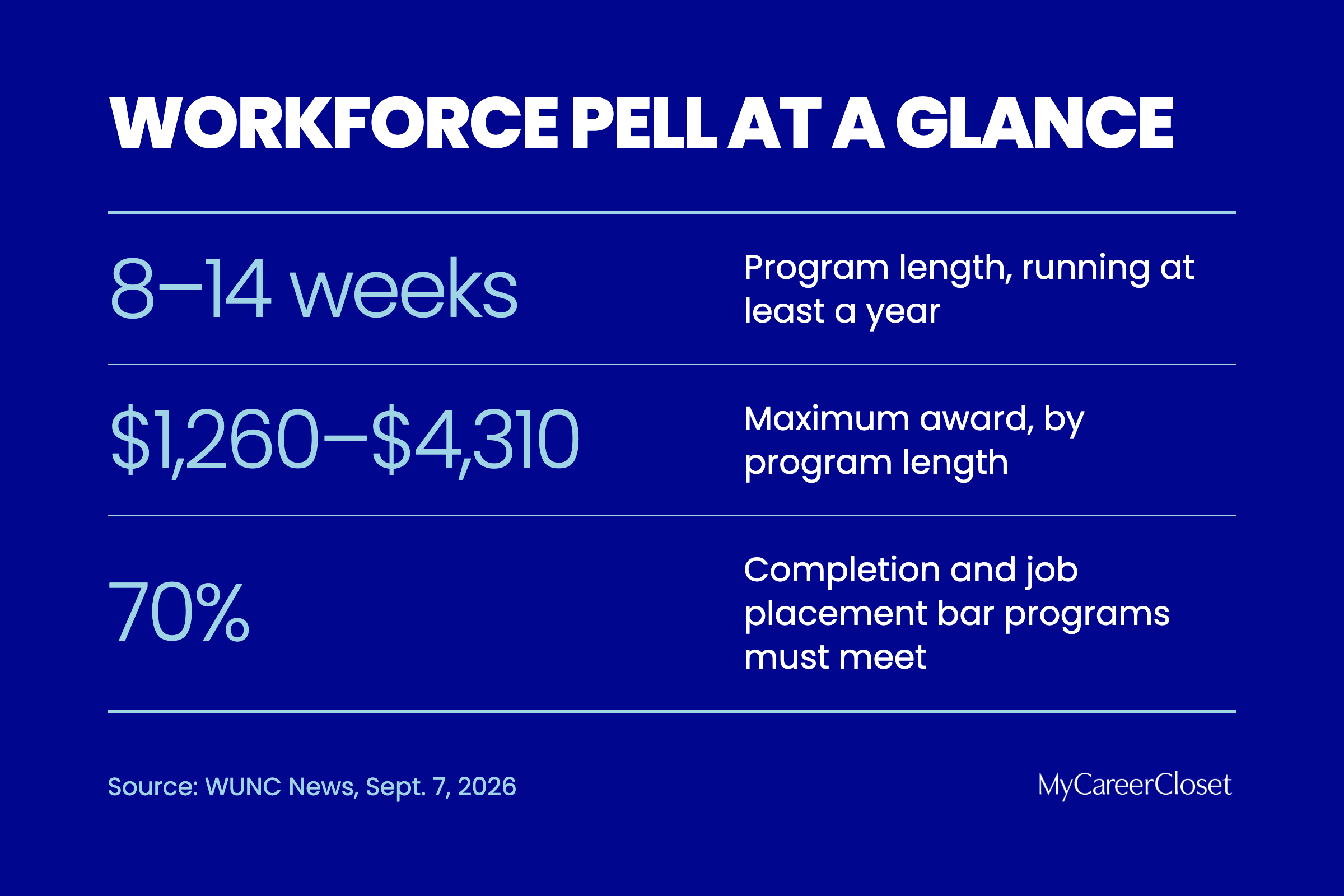
Awards scale with program length, family size and income.
For comparison, a full-time traditional Pell grant tops out at $7,395 this year. For programs that price short-term credentials near these amounts, Workforce Pell can lower the cost barrier for many of the learners you serve.
Who and what qualifies
Programs must run 8 to 14 weeks, have been operating for at least a year, and lead to credentials that pay off right away and can stack toward further training.
Fields include in-demand, hands-on roles such as:
Nursing assistant and medical assistant
Emergency medical technician (EMT)
Phlebotomist
Welder
Truck driver
Electrical line worker
Firefighter
IT support technician
Learners must be low- or moderate-income and eligible for Pell, the same test used for traditional Pell grants. Building FAFSA completion into intake is the simplest way to find out who qualifies.
The 70% bar: placement is now part of the deal
To qualify, a program has to show that at least 70% of its learners complete and get placed in jobs, and that graduates go on to earn more. Enrollment alone won't keep a program eligible; outcomes will.
Questions worth asking as you plan or apply:
Which of our 8- to 14-week programs already meet the one-year operating requirement?
What are our current completion and job placement rates, and how do we track them?
What support do learners get between finishing the credential and starting the job?
Who owns career readiness: instructors, career services, or an outside partner?
Closing the gap between credential and job
Short programs move fast, and hiring follows right behind. Learners who earn the credential still have to present well on paper and in the interview room, and many career changers have never had support with either. Three things move placement:
Resumes that translate experience. Learners need help leading with the new credential and connecting past work to the new role.
Interview preparation. Practice with common questions and clear stories about reliability and pressure, before the first employer call.
Professional presentation. The right attire for a clinical interview, site visit or video call removes a barrier many learners can't solve on their own.
That's where MyCareerCloset comes in. We partner with schools and workforce organizations to give their learners career-readiness support and professional attire, so they show up ready for the job and your placement numbers reflect the training you deliver.
The bottom line
Workforce Pell opens short-term training to more of the learners you serve, and ties funding to whether they get hired. Review which programs qualify, start tracking completion and placement now, and plan career readiness into the program from day one. To talk about bringing MyCareerCloset to your learners, visit mycareercloset.org.
Sources
As Pell grants expand, students see openings to afford short-term job training (WUNC News, Sept. 7, 2026)
U.S. Department of Education approves Workforce Pell Grant program in Indiana (Ivy Tech Community College, Aug. 19, 2026)